Loading...


Loading...
Welcome to Sliding Puzzle, the timeless tile-arranging brain teaser that has challenged and delighted children for generations through its deceptively simple yet genuinely engaging mechanics. This classic puzzle game presents a scrambled image broken into square tiles with one strategic empty space, challenging kids ages 7 and up to slide tiles systematically into that space until the complete original image is restored with the empty space positioned in the bottom right corner. What appears straightforward at first glance quickly reveals genuine cognitive complexity as children discover that every tile movement affects future possibilities, requiring careful planning, spatial visualization, and sequential thinking to achieve the satisfying moment when the final tile clicks into place and the complete picture emerges. Perfect for elementary and middle school students building problem-solving foundations, parents seeking screen time that exercises spatial intelligence, and teachers looking for classic logic puzzles that genuinely challenge cognitive skills, Sliding Puzzle delivers the ideal combination of accessible gameplay and substantive brain training for comprehensive spatial reasoning development through a puzzle format that has proven its educational value across decades of use in homes and classrooms worldwide.
• Classic sliding tile puzzle mechanics with one empty space for strategic tile movement • Scrambled images broken into square tiles creating visual restoration challenges • Adjacent tile sliding system requiring only tiles touching the empty space to move • Multiple image options providing varied puzzle experiences across different pictures • Progressive difficulty levels from simple 3x3 grids to challenging 5x5 configurations • Move counter tracking efficiency and providing performance metrics • Undo feature allowing learning from mistakes without complete restart frustration • No time limit permitting stress-free strategic thinking at each child's natural pace • Clear visual feedback showing which tiles can slide into the current empty space • Satisfying completion animation celebrating successful image restoration • Clean intuitive interface optimized for kids ages 7 through 14 • Touch and click controls working seamlessly on tablets, phones, and computers • Hint system available for children learning puzzle-solving strategies • Completely free access to professional-quality classic puzzle entertainment
Sliding Puzzle stands as one of the most educationally valuable classic games because it directly exercises spatial reasoning in ways few other activities can match. When children work to restore a scrambled image by sliding tiles one at a time, they engage in complex spatial visualization requiring them to mentally track how tiles relate to each other, predict how moving one tile creates new movement possibilities, understand that certain tile positions enable or prevent access to other tiles, plan sequential moves that progressively work toward the solution, and maintain a clear mental image of the target configuration throughout the solving process. This multi-layered spatial thinking directly supports mathematics learning particularly in geometry, visual problem-solving across all subjects, engineering and architectural thinking for future STEM careers, and general logical reasoning applicable to countless real-world challenges. Research in cognitive development consistently shows that spatial reasoning is highly trainable through targeted practice and strongly predicts academic success across multiple domains, making Sliding Puzzle significantly more than simple entertainment—it's genuine brain training with documented educational benefits that justify its enduring presence in classrooms and educational game collections worldwide.
Playing Sliding Puzzle regularly builds spatial reasoning essential for mathematics and engineering, develops sequential thinking required for multi-step problem solving, strengthens planning abilities by teaching children to think several moves ahead, improves visual organization skills for understanding how parts relate to wholes, enhances logical thinking through systematic tile arrangement strategies, builds patience and persistence when facing complex challenges, develops metacognitive skills as children learn to evaluate their own solving strategies, and provides satisfying completion experiences that build confidence in tackling difficult problems. For children aged 7-9, Sliding Puzzle offers accessible entry into strategic thinking with simpler 3x3 configurations that build confidence while exercising spatial skills. For kids aged 10-12, intermediate 4x4 puzzles provide appropriate challenge that genuinely exercises problem-solving without overwhelming frustration. For students aged 13-14, complex 5x5 configurations offer sophisticated spatial challenges comparable to advanced logic puzzles while maintaining the satisfying tactile feedback of the tile-sliding mechanic that makes achievement feel tangible and rewarding throughout the solving journey.
One of Sliding Puzzle's greatest educational strengths lies in how it naturally teaches children systematic approaches to complex problems through direct experience rather than abstract instruction. Children quickly discover through trial and error that random sliding rarely leads to solutions, instead requiring strategic approaches such as solving the puzzle row by row from top to bottom, positioning corner and edge pieces first before interior tiles, creating temporary disorder to achieve long-term organization, planning multiple moves ahead before committing to the first slide, and using backward reasoning to identify which tile positions enable desired future movements. These problem-solving strategies transfer directly to academic tasks like essay writing that requires organizing ideas systematically, mathematics word problems requiring multi-step planning, science experiments demanding careful procedure sequencing, and countless real-world challenges requiring systematic thinking rather than impulsive action. Parents and teachers who observe children working through Sliding Puzzles over time consistently report noticeable improvements in how children approach other challenging tasks with greater patience, planning, and strategic thinking rather than frustration and abandonment when immediate solutions aren't apparent.
Sliding Puzzle serves excellently as both a classroom teaching tool and a home learning activity that genuinely exercises cognitive skills during screen time. Teachers can use Sliding Puzzle for morning brain warmup activities that activate spatial thinking before mathematics lessons, logic challenge stations during indoor recess or enrichment time, differentiated instruction where students work on appropriately challenging grid sizes, and assessment of spatial reasoning abilities through observation of solving strategies employed. Parents appreciate Sliding Puzzle as screen time that genuinely exercises children's brains rather than passive entertainment, car trip activities that keep minds engaged during travel, after-school mental exercise that complements homework without adding academic pressure, and evening wind-down activities that focus attention without stimulating hyperactivity. The self-contained puzzle format requires no adult supervision once children understand the mechanics, making it ideal for independent practice while the move counter and difficulty levels provide clear progression metrics showing improvement over time. Whether used for focused 15-minute brain training sessions or longer sustained puzzle-solving practice, Sliding Puzzle consistently delivers the spatial reasoning exercise and systematic thinking development that children aged 7 through 14 need for academic success and cognitive growth.
Classic Brain-Teasing Challenge
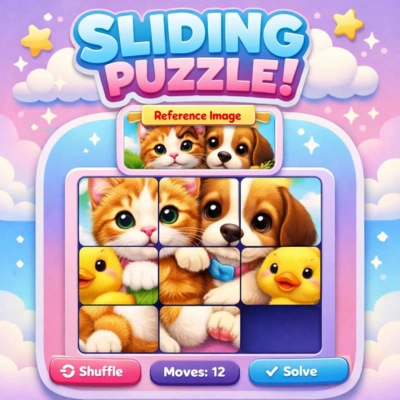
Sliding Puzzle is a classic logic game where kids move tiles around a board to restore a complete image. I can tell you this is one of the best spatial reasoning games for children who need to develop problem-solving strategies and visual planning skills.
Sliding Puzzle is a traditional tile-arranging game designed for kids ages 7 and up. The puzzle displays a scrambled image broken into square tiles with one empty space. Kids slide tiles into the empty space one at a time, working systematically to restore the original image with the empty space ending in the bottom right corner.
We started playing Sliding Puzzle when my daughter's teacher mentioned that spatial reasoning activities would help with her geometry lessons. "If I move this tile here, then that one can go there." This strategic thinking was exactly what her teacher recommended for math problem-solving.
Why kids love it: The puzzle looks simply but offers genuine challenge. There's satisfaction in watching a jumbled image slowly come together through careful planning. My daughter now challenges herself to solve puzzles in fewer moves, turning it into a personal game of strategy and efficiency.
Sliding Puzzle shows a grid of tiles forming an image, with one empty square. Kids can only move tiles that are directly next to the empty space - above, below, left, or right. Clicking a tile next to the empty space slides it into that space, creating a new empty space where the tile was. The goal is arranging all tiles to form the complete image with the empty space in the bottom right corner.
Unlike jigsaw puzzles where pieces can be moved anywhere, sliding puzzles restrict movement to adjacent tiles only. This constraint requires planning several moves ahead, kids must visualize how moving one tile affects where others can go next. This forward-thinking develops crucial problem-solving skills.
Before making any moves, study what the completed puzzle should look like. Understanding the target helps you recognize when tiles are in correct positions.
Most successful strategies begin by positioning corner tiles correctly. My daughter learned to place the top-left corner first, then work across the top row. This systematic approach works better than random sliding.
Once the first row is correct, move to the second row. Complete each row before moving down. This methodical progression prevents accidentally disrupting already-solved sections.
The final two rows are trickiest because you have limited movement space. This is where planning multiple moves ahead becomes essential. Sometimes you need to temporarily mess up a row to position tiles for the final solution.
The puzzle is solved when all tiles show the correct image with the empty space in the bottom right corner. Challenge yourself to solve it again in fewer moves or less time.
Most children start sliding tiles randomly hoping the image will magically appear. This almost never works. The key is systematic planning, decide which tile needs to move where.
Before clicking any tile, mentally trace where it will go, where the empty space moves, and what tile you can move next. Thinking three moves ahead prevents getting stuck in positions where you can't progress.
The empty space is your tool, position it deliberately. If you need to move a tile from the left side of the board, work to get the empty space to the left of that tile first.
Sometimes you need to scramble a nearly-solved row to maneuver a specific tile into position. Don't get discouraged when this happens, it's part of the solution process, not a mistake.
If completely stuck, reset the puzzle and try a different strategy. My daughter often solves puzzles more efficiently on her second or third attempt because she's learned from previous approaches.
After many puzzles, experienced players recognize common stuck positions and know the move sequences to fix them. These patterns become automatic, speeding up solving dramatically.
Challenge yourself to solve in the fewest moves possible. This requires planning entire sequences before executing any moves.
Absolutely! Sliding Puzzle is excellent for elementary and middle school children building logical thinking and visual planning abilities. Research shows that puzzle play significantly improves how kids understand space and objects, which directly helps with math and science learning.
Why it works well for school-age kids: These puzzles teach children to mentally picture how objects move and fit together. Studies show that kids who regularly play with puzzles and blocks perform better in math and science subjects. The visual thinking skills gained transfer directly to geometry understanding, which becomes important in grades 4-8.
Life skills developed: The game teaches kids to break big challenges into smaller steps, think ahead before acting, recognize when a strategy isn't working and adjust, and keep trying despite frustration. These thinking habits help in school subjects and everyday situations requiring careful planning.
Long-term benefits: Educational research confirms that puzzle play strengthens children's visual and planning abilities. The mental rotation practice builds cognitive abilities used across science, technology, engineering, and math subjects.
Remembering what the completed picture should look like while moving tiles exercises short-term memory. This same memory skill helps kids follow multi-step instructions in class, remember math formulas, and keep track of assignments.
Sliding puzzles can be tough, especially near the end. Kids learn to stay calm when stuck, try different approaches, and not give up when something is hard. This persistence matters more than natural talent for long-term school success.
Solving a puzzle requires concentration from start to finish. Regular practice improves how long children can focus on one task, directly helping with homework completion and test-taking stamina.
What age is best to start sliding puzzles?
Most children develop the spatial reasoning and patience needed for sliding puzzles around age 7. Younger children (5-6) can try with adult guidance using simple 3x3 puzzles, but many find the planning requirement frustrating until they're a bit older.
How long does it take to solve a puzzle?
This varies dramatically by puzzle size and skill level. Beginners might take 10-12 minutes on a 4x4 puzzle. Experienced players can solve the same puzzle in 3-5 minutes. My daughter's time dropped from 12 minutes to 4 minutes over three weeks of regular practice.
Are there different difficulty levels?
Yes! Puzzle difficulty depends on grid size. A 3x3 puzzle (8 movable tiles) is easiest and good for beginners. 4x4 puzzles (15 tiles) offer moderate challenge. 5x5 puzzles (24 tiles) are quite difficult and suitable for experienced solvers. Start small and progress gradually.
Can this help with school math?
Absolutely. Spatial reasoning developed through puzzle play directly supports geometry understanding. Research shows that children who play with puzzles and blocks regularly perform better in math and science subjects.
Is it better than jigsaw puzzles?
They're different but both valuable. Jigsaw puzzles build visual discrimination and matching skills. Sliding puzzles specifically develop systematic problem-solving and sequential planning because the movement restrictions require strategy rather than just matching. Both offer unique cognitive benefits.
What if my child gets frustrated?
Frustration is normal with sliding puzzles, they're genuinely challenging. Encourage taking breaks, trying different strategies, or starting with easier puzzle sizes. Model patience by working through challenging puzzles yourself while verbalizing your strategic thinking process.
After watching my daughter and several other kids play Sliding Puzzle over four weeks, develops crucial skills supported by educational research, teaches systematic problem-solving applicable to all academic subjects, offers genuine challenge without time pressure or competition, builds persistence and frustration tolerance through appropriate difficulty, and completely safe for independent play.
Best for: Kids who enjoy logical challenges, children preparing for geometry in school math, parents wanting screen time with measurable cognitive benefits, teachers seeking independent problem-solving practice activities.


